

Skip to content

Bug bounty hunting with multiple AI models

Franz Bettag builds and operates his own platform for AI-assisted security research. It combines specialist agents, model selection for each workflow phase and fresh verification of findings. His security work has public recognition: #2 VDP researcher in Germany on HackerOne, January–March 2026.

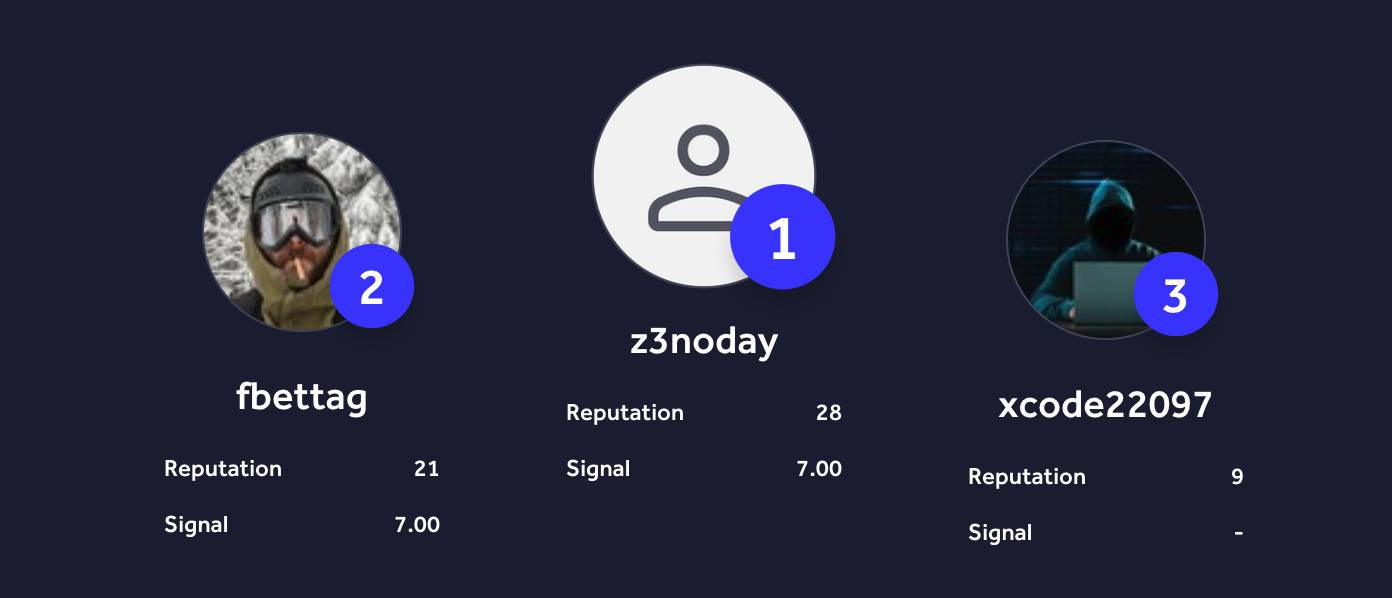
Historical HackerOne ranking screenshot: fbettag in second place, with 21 reputation and a 7.00 signal score.
Ranking screenshot from the talk on 16 April 2026. The event listing identifies the ranking as Germany, January–March 2026. Event listing

Problem

A suspicion needs proof

AI can examine large codebases and attack surfaces. It can also produce plausible but false claims. A sound report needs an authorized scope, a reproducible vulnerability and demonstrated impact. Research, independent checking and documentation place different demands on a model.

Role

Design, development and operation

Franz Bettag designs, builds and operates the platform for his own bug bounty work: backend and CLI, agent tools, phase prompts, model profiles and NixOS configuration. He defines the workflow and assesses its results through his work as a security researcher.

Architecture and model selection

Shared state, distributed work

A Go backend stores campaigns, findings, submissions and runs centrally. Workers access its API through a shared CLI. NixOS defines the infrastructure. Each run records its model profile, start and end times, and status; artifacts such as logs and screenshots carry a run reference and SHA-256 checksum.

Six model families

The inspected configuration includes OpenAI GPT/Codex, Anthropic Claude, GLM, Kimi, MiniMax and DeepSeek models. The launcher allows a separate model profile for each phase, so research and verification can use different models. Selection is explicit; this does not constitute an automatic ranking of the best model for each task.

The actual AI workflow

1 · Hunt

Specialist agents investigate the selected scope. Platform-specific prompts account for the relevant reporting process. Findings and evidence are stored for subsequent phases.

2 · Triage

Phase prompts require fresh, practical reproduction. A finding is classified as reportable, needs-review or false-positive. Ambiguous or unstable results should return for review; a model’s claim alone does not establish evidence.

3 · Chain

Verified findings are examined for connected impact and prepared as draft reports. Instructions exclude purely theoretical chains and claims outside the authorized scope.

4 · Submit and feedback

QA instructions require reproducible evidence, appropriate attachments and an assessment supported by demonstrated impact. Drafts receive ready or needs-revision status. Feedback feeds into further work.

Results and context

#2 VDP researcher in Germany

The public event listing confirms second place for January–March 2026. The historical ranking screenshot shows fbettag with a 7.00 signal score and 21 reputation points in that view. This is a Vulnerability Disclosure Program ranking, rather than a global rank or a leaderboard of bounty payouts.

What this brings to your model comparison

This work provides experience with model behaviour across long tool workflows, verification and conflicting results. For your use case, we turn that experience into concrete test cases, verifiable quality criteria and cost per accepted result. Your test set determines which model wins.

Technical snapshot

Architecture, phase instructions and model configuration were checked against the project’s own source code on 7 September 2026. This snapshot is separate from the historical ranking. No measured savings rate, overall report acceptance rate or causal contribution of individual models to that ranking is claimed here.